
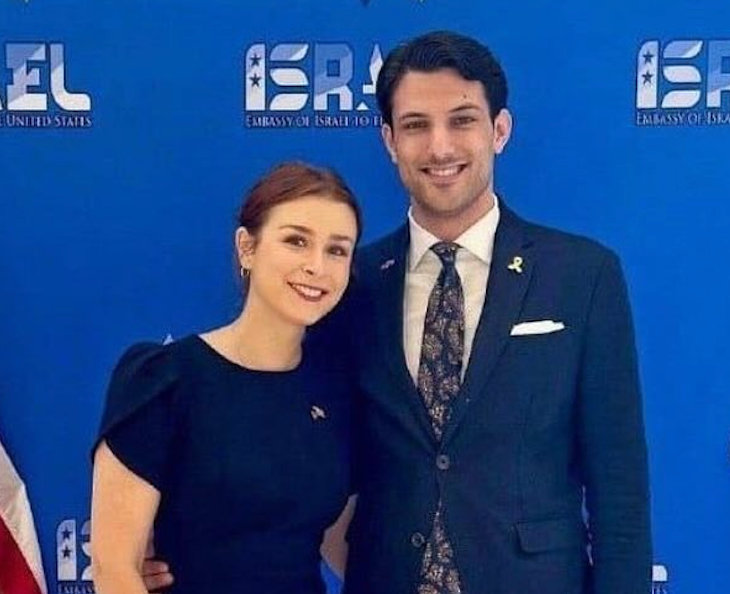
Yaron Lischinsky and Sarah Milgrim had been working to advance peace in the Middle East at the Israeli embassy in Washington. Just days before Yaron was about to take Sarah to Jerusalem to propose, they were gunned down by a terrorist screaming “Free Palestine” as they were leaving an event for young diplomats on May 21, 2025.
Yaron’s family is well known to us in Jerusalem and the body of Messiah was devastated by his death. Now, a year on, we are seeing unimaginable progress in the peace deals he worked so hard towards, with a breakthrough in diplomatic relations between Israel and Lebanon announced in Washington D.C. — the very place where he fell.

We talked to Yaron’s father, Daniel Lischinsky, about his son’s legacy as we come up to his “Yahrzeit,” the year’s anniversary of his death — a significant milestone in Jewish tradition.
“That’s the thing, everything he did was quite confidential,” said Daniel. “When he spoke to us, he would say, “I cannot speak on the phone” but we knew that he was involved in the Abraham Accords. He was very in favor of the Abraham Accords.”
With five children, Daniel and his wife Ruth had to economize on bedrooms, a factor that proved to be significant in the direction of Yaron’s life. “Hanan was his best friend. They grew up together in the same room.” Yaron was a sportsman at heart but Hanan influenced him to read. “He was not a person of books, but Hanan was. From childhood, Hanan was already an intellectual, and he had books in the room… Yaron got interested, slowly, slowly, more and more in reading, and developing his intellect.”
Hanan had served in IDF intelligence, which also had a bearing on Yaron’s path in life and career in Middle East Affairs. He ended up working for the Middle East Department in the Israeli Embassy in Washington. ”He was a Middle East analyst,” Daniel summarized, involved in public diplomacy and international relations built privately.
“Their department was only two people, so he was involved in everything,” said Daniel, explaining that Yaron and his boss, the Minister-Counselor for Middle East Affairs at the Embassy, were responsible for the entire division.
“He had so much initiative. He liked to meet with people from think tanks and other embassies, other diplomats of course, it was part of his work. He went representing the Israeli embassy a lot because his department was only two people, so sometimes, like on the night when he was killed, his boss went to another meeting, and he went to this meeting,” said Daniel, referring to the Young Diplomats Reception hosted by the American Jewish Committee (AJC). “He often represented the embassy, like a diplomat.”

“They were preparing him to be a diplomat in the future,” he added.
Yaron had delayed enrolling for the one-year course because there were so many other things he was interested in and opportunities he saw that were opening up, but the embassy saw his potential and were eager to train him for the role.
Daniel relayed that Yaron’s boss, Noa Ginosar, saw how easily he connected with people from other Middle Eastern nations.
“She came to a meeting and he had brought friends from think tanks and diplomats from other countries, one was Jordanian, one Moroccan, and she said, “There’s a new Middle East all around him!””
The AJC arranged an event to commemorate Yaron’s life, inviting his friends and family but there was also a diplomat from another Middle Eastern country there. “He said, You know, it’s not public, but I appreciate Yaron very much, so I wanted to come to meet the parents. I think he did such a great work.”

They also received a letter from another dignitary from Morocco who considered Yaron a dear friend.
“Yaron was very much a peacemaker… he was really for speaking and understanding between different people, different religions. He was really a person that looked to the human being that you are, not to your title — he was never impressed if you were ambassador or whatever,” Daniel continued. “He wasn’t intimidated.”
God encourages Israel’s leaders in the Torah to do exactly that in order to establish justice and peace: “You shall hear the small and the great alike. You shall not be intimidated by anyone, for the judgment is God’s.” (Deuteronomy 1:17)
“He respected the human being in every person, not only the title and which country you are from, or which religion you are. He looked to the human being in everybody. That’s why the people loved him so much…. He touched people from different embassies and different backgrounds.”
As strong as his walk with Jesus was, Yaron’s faith was not automatically inherited from his family. Daniel described how his son had been on a deep search, reluctant to accept the faith of his parents without question. Daniel is Jewish and the family attend a Messianic congregation, but after wrestling with different expressions of Messianic Judaism, Yaron found his spiritual home in a more Gentile expression of Christianity.

“He liked, very much, the Anglican liturgy, and the preachings of David Pileggi,” Daniel said, referring to the rector of Christ church in Jerusalem. “At the end, he was going to an Anglican (Episcopalian) church in Washington, DC.”
“He was very convinced of the Lord Jesus — who the Lord was, and what the Lord did for us. What it means to live: not I live anymore, but Jesus lives in me, like the Apostle Paul says (in Galatians 2.20). But at the same time, he was so respectful to other religions.”
“He was the only one that had this identity crisis, and to search for who he is… my wife is not Jewish but I am, so he was not holding so much to the Jewishness, even if we celebrate Pesach (Passover) and celebrate Shabbat when we are at home. He was proud that he came from the Jewish people, but more proud of what Jesus did on the cross.”
Significantly, Yaron’s Yahrzeit coincides with the Feast of First fruits, known as Shavuot or Pentecost.
“It’s incredible the seed that falls on the earth is already bringing fruit – so many people have told us that they are so touched. It’s bringing fruit from the Lord,” says Daniel. “It’s not something that I am trying to organize.”
Already an ambulance has been donated in his honor, a book about his life is in the works, a scholarship fund set up for new immigrants, and a new Masa program for Jewish young people, as well as countless people inspired towards the peace he pursued — and the Prince of Peace he was following.
Yaron came to Israel at 14 years of age, a new immigrant without Hebrew, and succeeded serving in the Israeli embassy in Washington, yet the purity of his life was equally inspiring.
“It’s such a legacy, such a testimony. It’s huge. It’s a miracle,” marveled his father.

Ironically, the theme of the event they had just attended before they were murdered was entitled, “Turning pain into purpose.” It brought members of the Multifaith Alliance and IsraAID together to discuss humanitarian diplomacy and regional cooperation in response to the crises in the Middle East. Sarah’s parents described it as “a meeting of young professionals and diplomats from various embassies, to explore ways to help Gazans and build peace.”
“I think Washington is a place where all these people meet… That was exactly the place for him, exactly the time for him. So he was trying to bring all the people, all the Middle East together,” said Daniel, reflecting on the significance of Yaron’s short life on earth.
Yaron’s body was returned to Israel, accompanied by Noa Ginosar, the Minister-Counselor for Middle East Affairs at the Embassy in Washington where he had served for over two years. At his funeral ambassadors and dignitaries paid homage to his life as if it was over.
But it isn’t.
Truly, truly, I say to you, unless a grain of wheat falls into the earth and dies, it remains alone; but if it dies, it bears much fruit. (John 12:24)

May 2026